



We are just a fleeting moment in the life of this planet. The Yucatan cenotes, as we know them today, began to form millions of years ago. Understanding what they are and how they came to be not only makes them more fascinating—it invites us to see them through a new lens: one shaped by time, geology, and our own brief presence on Earth.
Earth, Humans, and the Cenotes of Yucatán
Formed deep within the Earth, the Yucatan cenotes existed long before us, and they will likely remain long after we’re gone. Hidden within them are traces of the past—fossils of extinct animals and remains of ancient humans. In silence, these watery windows to Earth’s interior observe our passing, unaware of our bubbles and fascination. We are just visitors in their timeless, underwater corridors.
Earth has been around for approximately 4.5 billion years. To put that into perspective: if all that time were compressed into a single day, life would appear at 2:00 AM, multicellular organisms at 6:00 PM, dinosaurs at 10:00 PM, and humans just before midnight. That’s where we stand in this planet’s grand timeline.

How Were the Yucatan Cenotes Formed?
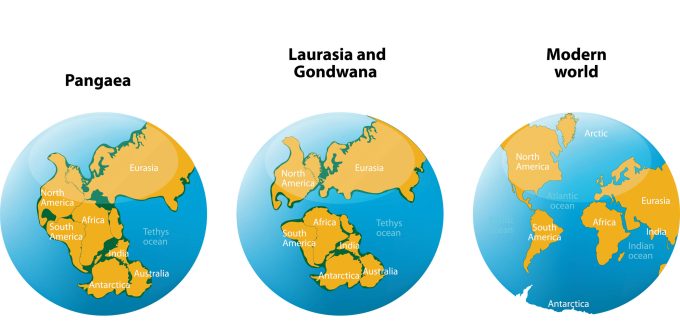
Millions of years ago, the Yucatán Peninsula lay beneath the sea. Back then, the world’s landmass formed a single supercontinent known as Pangea. Around 200 million years ago, the continents separated, and about 100 million years ago, sea levels dropped due to glaciations, revealing what is now the Yucatán Peninsula.
The surface of Yucatán is made up of thick layers of fossil-rich marine sediment—remnants of coral, shells, and marine creatures from ancient seas. These layers gradually formed limestone, a porous and soluble rock that became the foundation for the Yucatan cenotes.
Even today, as you walk through the jungle, you can spot fossilized coral and shells embedded in the rock—evidence of a time when this land was the ocean floor. Within the cenotes, now filled with crystalline water, these marine fossils are still present, preserved in silence.
Nature’s Alchemy: The Power of Dissolution
The Yucatán Peninsula is flat, with no mountains or valleys. Its highest point, Sierra de Ticul, barely reaches 200 meters above sea level. Because of this lack of slope, rainwater doesn’t run off the surface—it sinks in.
Three key elements worked together to create Yucatán’s vast cave systems: carbonic acid (from rainwater mixing with CO₂), saltwater, and hydrogen sulfide from organic decomposition. The most influential of these was carbonic acid.
As the slightly acidic rainwater filtered through cracks in the limestone, it began to dissolve the rock, gradually carving tunnels and underground rivers. These waters eventually found their way to the sea, creating one of the most complex cave networks on the planet. In some places, cave ceilings collapsed, connecting these passages to the surface—and cenotes were born.
Stalactites, Yucatan Cenotes, and the Ice Ages
Inside these now-dry caves, if the temperature and humidity were right, dissolved calcium carbonate began to solidify, forming stalactites, stalagmites, and other formations known as speleothems.
This process began on a large scale about 2 million years ago. As the Earth entered cycles of glaciation and warming, sea levels rose and fell, leaving some caves flooded and others dry.
At the end of the last Ice Age—roughly 18,000 years ago—the sea rose to its current level. Freshwater from rain continued to filter down, forming Yucatán’s most vital aquifer and filling the cenotes we swim in today.
The Largest Underwater Cave System on Earth
To this day, cave divers have explored hundreds of kilometers of these underwater rivers—and much still remains unmapped. Beneath the jungle, Yucatan cenotes are just the visible openings into a massive hidden labyrinth.
The longest underwater cave system on Earth, Sac Actun, lies within the Yucatán. It spans more than 250 kilometers of explored passages. Each set of interconnected cenotes is called a “system” by explorers, who continue to chart this remarkable underground world.
The Chicxulub Meteorite’s Lasting Impact
In the 1970s, Mexican scientists searching for oil discovered something far more significant: a massive 140-kilometer-wide depression under the sea—the Chicxulub crater. It was created by the impact of a 40–60 km wide meteorite that struck Earth about 65 million years ago, causing the extinction of the dinosaurs.
That impact shattered the limestone bedrock, creating countless cracks and fractures. This made it even easier for water to penetrate and carve out the underground cave systems we now explore. Today, the area surrounding the crater has one of the highest concentrations of Yucatan cenotes.

Do you want to kniowo more?, Click here.
Yucatan Cenotes: Nature’s Time Capsules
During dry glacial periods, the underground rivers were empty. The cenotes—open, dry pits—became natural traps where animals (and sometimes humans) would fall in and never return. Most remains decomposed over time. But those that ended up submerged in freshwater were preserved for thousands of years.
Today, bones over 12,000 years old have been found at the bottom of Yucatán’s cenotes and caves. These remains include extinct species such as saber-toothed cats, giant ground sloths weighing two tons, early camels—and even the bones of prehistoric humans. These cenotes are not just geological wonders; they are time capsules filled with forgotten stories.
Want to learn more about the Yucatan cenotes and their history? Dive in—literally—and follow a path that began long before we arrived… and will continue long after we’re gone. Explore our tours

